Table of Contents
Longsword Tournament Rules for Lone Star Open 2018
General Information
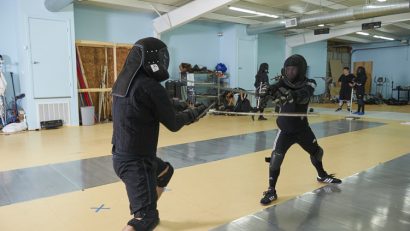
- Tournament: Open Steel Longword feder (limited wrestling and takedowns permitted)
- Participation is open to all attendees over 18 years of age or 15 with signed parental consent
- The tournament is Bring Your Own Sword but is subject to equipment safety check and approval. See Equipment section below for more information on approved equipment.
Rules Summary
DON’T GET HIT. We mean it. Getting lots of hits alone will not be sufficient to win and advance out of pools. Fight safe, win, but minimize getting hit.
All hits landed before the referee halts an exchange will be considered for scoring. Each fighter will receive points for the highest value strike. If both fencers are hit, i.e. double hits, all hits are fully weighted.
Double hits (both fighters strike each other in the same exchange) will be factored in as a penalty via match points and will affect your tournament advancement.
This event will be on unpadded rubberized gym floors. Wrestling and takedowns ARE PERMITTED within limits as they’ve always been. Read the rules below, be careful of assumptions and ask questions.
Excessive injury to participant or damage to property incurred during a bout due to, but not limited to, thrown or dropped swords, excessive force, and unsportsmanlike behavior may result in warnings and/or penalties up to immediate expulsion from tournament. These penalties are ultimately up to the discretion of the organizers.
Seeding and advancement from the first round (pools) to the second round (eliminations) will be based on performance in your pool, prioritized by indicators:
- Match points (per fight for four fights: 9 points awarded for win, 6 points for a draw, 3 points for a loss. In each bout, one double hit will be forgiven but each double hit after will result in a deduction.)
- Wins (bouts won in your pool)
- LOWEST total points received (you minimized hits from opponent)
- HIGHEST total points scored
Intention of the Rules
Our HEMA tournaments are full-contact, but participants are expected to demonstrate skill, restraint, and courtesy to their opponents. The judges will do their best to recognize skillful actions demonstrating clear control of an opponent in time, lack of attack, etc. Heavy strikes to unarmed/incapacitated opponents, repeated use of unnecessary force, multiple afterblows well after the scoring tempo, or actions that prevent an opponent from continuing are unacceptable and WILL result in a penalty (up to and including disqualification; see Penalties section below).
These rules are not meant to accurately represent real, lethal combat. Tournaments and rulesets are inherently limited representations of actual fighting. They prioritize bladed weapon skill sets by the organizers’ discretion while still allowing for limited non-weapon strikes or grappling actions.
Our intent is to create a competitive environment that allows participants to safely test and challenge varying aspects of their skills and training. Lightly touching an opponent with a sword is not necessarily sufficient to score a point, but neither is it necessary to hit with excessive force. Judges will exercise full discretion in gauging what constitutes a valid hit and will decide whether participants made valid efforts to land their strikes or to control their opponent’s weapon in cases of double hits.
General Rules
A longsword bout is fought to the first condition of a 3 minute time limit, 10 exchanges or 15 points.
Fight action in an exchange will continue until one or more judges see one or more potentially scoring hits and call “Point!”. Within a single tempo of the hand or the foot, the referee calls “Break!”. Any actions landing a hit outside the halt are out of tempo and are not to be scored.
The 3 minute clock will run continuously unless the referee calls judges to the middle for discussion, an injury occurs or a safety check is called.
Possible Outcomes of an Exchange
- One fighter lands one or more hits: record the highest value hit
- Both fighters hit each other within a single time of hand or foot (double hit): each fighter’s highest value hit is recorded as is the occurrence of the double
- (reminder: one double hit per bout is forgiven, each subsequent double hit results in the loss of a match point).
- One fighter hits, then the opponent delivers an “afterblow” within one additional tempo after the landing of the initial strike: both hits are counted
- One fighter hits, then the opponent takes two action times to hit: opponent’s hit is out of tempo and is not scored
- Not clear (no judge majority on scoring). If a majority of judges do not see or agree on scoring action, no points are awarded, and the bout continues. See Judging section below.
Process
- Referee asks judges, fencers and table if they are ready.
- Referee calls “Fight/Fence/Engage!”
- On observing a valid, point-scoring action, judge(s) call “Point!”
- Referee calls “Break!” and stops action
- Referee calls for fencers to reset and fencers return to their starting position
- Referee asks “Judges, score?”
- Judges indicate point value (low quality, 1 or 3) with batons. Ref counts flags for red then blue. Majority rules for each score individually.
- Referee announces “Red X, Blue X”, e.g. “Red 3, Blue 1!” as well as any double that occurred.
- Table responds with winner of the exchange and announces total running score, e.g. “Red 6, Blue 4!” and conveys any loss of match points resultant from a given exchange.
- Table announces next exchange, “Now third exchange”.
- Referee visually checks everyone in ring is ready and starts next bout.
“Halt” is to be called on realization of a need for equipment/safety check.
Judging
- Judges are to immediately tilt head down to the floor as soon as the bout stops and await the referee’s request for score. It should remain that way until the score is relayed to the table or the referee calls the judges to the center of the ring for discussion.
- In cases where a judge only partially observes scoring actions, the judge can indicate point values only for those they directly observe.
- Point value of 3 is portrayed by the judge holding his/her arm over their head with the coordinating color baton.
- Point value of 1 is portrayed by the judge holding his/her arm straight out to the side with the coordinating color baton.
- Point value of poor quality (or 0 points) is portrayed by the appropriately colored baton being held in front of the judge, pointing downward. This is to show that an action was witnessed but was of poor quality. *If red fencer has a quality 3-point hit while blue fencer has a poor-quality hit, the judge would hold the red baton over their head while the blue baton is held pointing out and down in front of their body*
- No action seen is portrayed by both batons being crossed in a “X” shape in front of the body.
- The majority score is relayed to the table for both fencers.
- If a double hit occurs, the judges will hold up their batons as normal and it will be up to the referee to differentiate if it was a double hit or an afterblow and relay that to the table to record.
- The referee is in control of the ring but has no personal scoring power, except for their ability to call double hits. His/her role is to run the match, stop the exchanges and ensure fighters stop when called to, make sure safety guidelines are being followed, and interpret/calculate majority points for each fighter after each exchange. The referee may call judges in to clarify what was seen and the points they are awarding but has no power as a tie-breaker. The referee is to call what is reported by the judges and if there is no agreement, the exchange is finished with no score and the bout continues.
Tournament Scoring
Per bout:
3 points:
- Cut or thrust to head/neck/shoulders (above jacket shoulder seams)
- Torso thrust
- Clean trip/takedown (one fighter remains standing)
- Clean, intentional disarm retaining opponent’s weapon (no double hit, no grappling tie-up)
1 point:
- Any other strike with a weapon head/edge/point (including pommel placement to mask only)
- Grappling achieving dominant position within a 5-count
- Ring out
- Geisel (one-handed whip strikes) regardless of target or type of strike
Double hits (both fencers strike each other in the same action before halt is called) will be factored as a penalty against your match point indicator (after the first is excused) each fight. These will be assessed by the referee’s discretion, but assume that if you both hit within the same time of the hand or foot, it will likely be counted as a double hit. Penalties for doubles will significantly affect your match points if done continuously.
Afterblows will not negatively affect match point seeding statistics, but late afterblows can result in a penalty.
The winner in a bout will receive 9 points for tournament advancement. A tied score will grant both fencers 6 match points. A loss of a bout confers 3 match points. There are base indicators but may not translate in the same way after double hits are accounted for.
The tournament will run in pools of five fighters in the open fencing round. Fighters will then be ranked by match points, wins, lowest points against, highest points scored (in order of priority).
The top will seed the single elimination bracket.
Valid Actions
Actions that will score points:
- A strike with the blade (cut, thrust, or slice)
- A clear, deliberate placing of the pommel on the opponent’s mask
- Fencer remains standing while successfully tripping or otherwise taking down an opponent to the ground. DO NOT ATTEMPT if you cannot place the opponent on the hard floor with reasonable control, care, and safety. This means no throws with opponent’s feet significantly off the ground.
- Dominance in wrestling- if both participants go to the ground, they will have time to count to five (approximately 5 seconds) to achieve dominance. Dominance is defined here as EITHER shoulder and/or hips on the ground or THREE points of contact other than feet (e.g. one knee and two hands, two knees and one hand). Per the Intention of the Rules, a participant does not need to actually or heavily strike a pinned or otherwise downed opponent.
Note: Wrestling actions may involve the sword (ringen am schwert).
Non-scoring actions:
- Open-hand and unarmed push-strike actions are permitted in order to create openings for valid scoring actions. However, consider them as direct actions and displacements, not full-power strike to injure. As with takedowns, DO NOT ATTEMPT if you cannot safely place the strike with control.
Forbidden Actions:
- Strikes to the back of the head, neck, groin, back of knees, spine
- Close hand strikes, especially to the mask
- Pressure, strikes, or thrusts against the spine or larynx
- In wrestling, grappling only the neck or head
- Any throw removing both of the opponent’s feet from the floor and/or impacting the head and spine on the floor
- Strikes or pressure on joints against the natural direction (i.e. joint locks at full extension, breaks, or strikes)
- Any strike which prevents an opponent from continuing to participate in the tournament.
Warnings/Penalties
If any referee or judge perceives that a fencer is acting unfairly, they will call a foul (indicated by a baton on the head) on that fighter. Examples of unsportsmanlike behavior include but are not limited to:
- Excessive force, generally defined by the opponent’s inability to continue participating in the tournament
- Striking well out of tempo to seek afterblow
- Continuing to wrestle or strike after “Break!” has been called
- Failure to engage in fencing action, by judges’ discretion. Defensive strategy is acceptable. Deliberately backing out of the ring to yield 1 point and prevent the opponent from potentially gaining 3 points is not acceptable.
Penalties
- First offense= warning
- Second offense= loss of 3 points
- Third offense= loss of bout
- Significant safety offense= discretionary, up to immediate removal from tournament
- Unsafe or disrespectful behavior WILL NOT be tolerated
Equipment
We will make every reasonable effort to help participants meet equipment requirements (some loaner equipment may be available). Contact us prior to the event if you will need equipment.
Steel Longsword Minimum Requirements
- All skin must be covered
- Fencing masks in good condition (free of significant rust) with a good fit and protection for back of head and neck.
- Throat protection with recommended consideration for larynx and collarbones (a leather, plastic or otherwise semi-rigid, padded gorget as sold for HEMA)
- Padded fencing jacket or gambeson with full arm, armpit, and point of hip coverage
- Rigid elbow/knee protection with coverage on the sides of the joints
- Solid, padded, rigid/semi rigid gloves with no gaps in padding, especially on fingers. Gloves and gauntlets will be heavily reviews for steel tournament for fencers’ protection
- Athletic cup for men. Women are encouraged but not required to wear pelvic protection.
- Rigid chest protection is required for women.
- Rigid protection for shins is recommended, but not required
- Steel armor must have no exposed burrs, unfinished edges/corners; edges must be rolled
- Mouthguard is recommended especially with wrestling permitted.